History & traditions
Why Guru Nanak Jayanti is celebrated — the life and message of Guru Nanak Dev Ji
The first Guru of the Sikhs
Guru Nanak Jayanti, also called Gurpurab or Prakash Purab, marks the birth of Guru Nanak Dev Ji, the founder of Sikhism and the first of the ten Sikh Gurus. He was born in 1469 at Rai Bhoi di Talwandi, a village near Lahore now known as Nankana Sahib in Pakistan, to Mehta Kalu and Mata Tripta.
The community celebrates his birth on Kartik Puranmashi, the full moon of the month of Kartik, which usually falls in November. Some early accounts of his life point to a birth in spring, in the month of Vaisakh, and scholars have discussed this; but the Kartik date has been the accepted tradition for a long time and is the one followed by gurdwaras worldwide.
A life spent travelling and teaching
Sikh tradition remembers Guru Nanak as a thoughtful child who questioned empty ritual. As a young man he worked at Sultanpur Lodhi, where, the janamsakhis (traditional life stories) say, he disappeared into the Kali Bein stream and returned three days later with the words that there is no Hindu and no Muslim — meaning that people are one before God.
He then set out on long journeys, known as udasis, with his companion Bhai Mardana, a Muslim musician who played the rabab. Tradition describes travels across India and beyond, to places such as Assam, Sri Lanka, Tibet, Mecca and Baghdad. The details vary between accounts, but the purpose was the same everywhere: he sang his hymns, talked with holy men of many paths and taught a simple faith.
What he taught
His message begins with Ik Onkar — there is one God, the creator, present in all. He taught naam japna (remembering God), kirat karni (earning an honest living) and vand chhakna (sharing with others). He rejected caste divisions and spoke of the dignity of women. His hymns are collected in the Guru Granth Sahib, which opens with his Mool Mantar and his long composition, Japji Sahib.
In his later years he settled at Kartarpur on the Ravi, where he farmed and where the first Sikh community grew around shared work, worship and langar — the free kitchen where everyone sits together on the floor as equals. He passed away there in 1539, having named Bhai Lehna, later Guru Angad Dev Ji, as his successor. Since 2019 the Kartarpur Corridor has allowed pilgrims from India to visit Gurdwara Darbar Sahib in Pakistan.
How Gurpurab is celebrated
Celebrations begin days earlier with prabhat pheris, early-morning processions singing hymns through neighbourhoods. Two days before the Gurpurab, gurdwaras begin an Akhand Path, a 48-hour unbroken reading of the Guru Granth Sahib that ends on the morning of the festival. A day before, a Nagar Kirtan procession is led by five Sikhs representing the Panj Pyare, with gatka displays, music and the Guru Granth Sahib carried on a decorated palanquin.
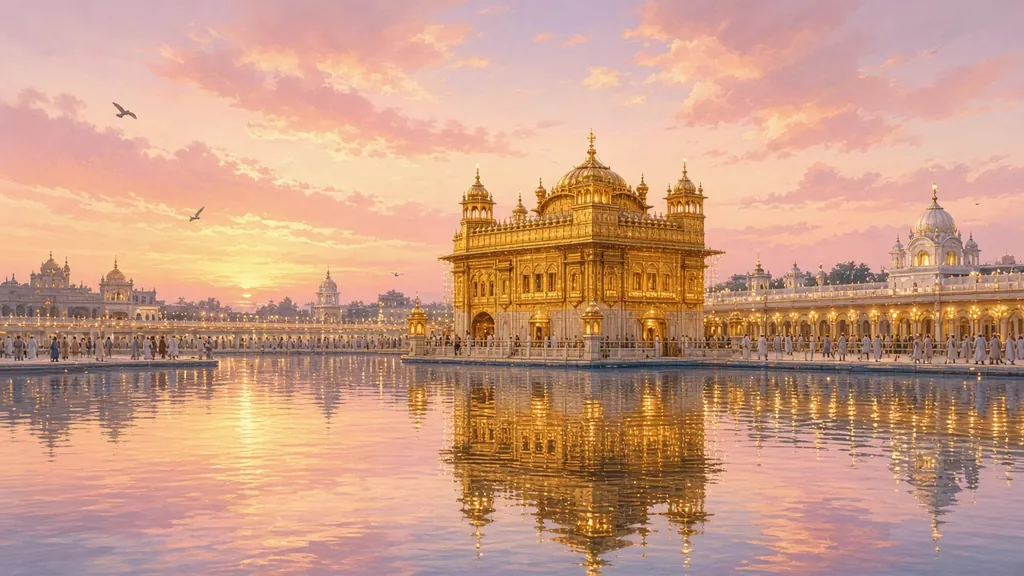
On the day itself there are kirtan and katha from early morning, and langar is served to everyone who comes, whatever their faith. Gurdwaras and homes are lit up at night. At Sri Harmandir Sahib in Amritsar the lights and fireworks over the sarovar make it one of the most beautiful nights of the year — which is why so many families plan a trip to Amritsar for Gurpurab.